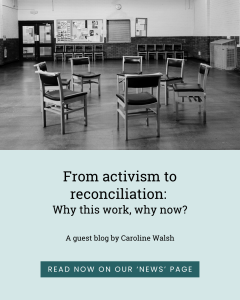
This is a guest blog by Caroline Walsh, an experienced Restorative Justice Facilitator.
We are living through a period of intensified division.
Public debate is harder, trust in institutions is fragile, and disagreement increasingly feels personal rather than political. What might once have been differences of opinion now often land as questions of identity, belonging, and threat.
This is often described as a new problem. It is not.
Over a decade ago, I found myself trying to make sense of similar patterns. At the time, I was not writing publicly. I was journaling, sometimes sharing reflections privately with friends, trying to process what I was noticing and experiencing. Even then, I had a growing sense that something in the relationship between people, institutions, and politics was beginning to fracture.
“Politicians had disconnected from the electorate, unable to effectively communicate with us, to take us with them through the democratic process.”
At the time, I did not yet have the language to fully understand what I was seeing. But I had already felt it.
Around the same period, my grandmother had died following three years in which our family fought to get her the care she needed and to maintain it. What we experienced was not just strain within a system. It felt like a breakdown in relationship.
“We felt her needs weren’t being met, our concerns not listened to… we were told we were making it up. We were not.”
The impact of that experience was profound.
“We had never felt so low, so helpless, so abandoned.”
What stayed with me was not only what happened, but what it revealed. A system designed to care had, in our experience, become something else.
“A paper-driven management system of targets and objectives… no longer a care system.”
At the time, I understood this as failure of policy, leadership, and accountability. What I did not yet understand was how deeply this was also about relationship.
My response then was activism. I believed in challenge, in argument, and in holding power to account. There is value in that, and it matters. But it was not enough.
Because beneath the arguments, something deeper was happening. People were not only disagreeing. They were feeling unheard, unseen, and, at times, dismissed or disbelieved. What I was witnessing, in both personal and political contexts, was not simply disagreement. It was disconnection.
Over the past twelve years, my work has shifted from activism towards reconciliation. Through my association with St Ethelburga’s Centre for Reconciliation and Peace, and through training in restorative justice, I was introduced to a different way of understanding conflict.
Restorative justice begins with different questions. What has happened? Who has been affected? What is needed now?
These questions do not remove conflict, but they change how we engage with it. They move us away from position and towards impact, and away from argument and towards relationship. They create space for people to be heard, sometimes for the first time.
What has become clearer in recent years is the role of emotion in shaping conflict. Fear, anger, and perceived threat are not side effects of polarisation. They are central to it. They shape how we interpret events, how we see each other, and how quickly situations escalate.
Looking back, I can see that what I was noticing in those private reflections were the symptoms. What I did not yet understand were the underlying dynamics.
This is where restorative justice becomes critical. It is not only a response to harm, but a way of rebuilding trust between individuals, within communities, and across institutions. This is reflected in the growing recognition of restorative approaches, including at the Restorative Justice Summit this May:
“Together, we will explore how restorative justice can rebuild trust across communities and institutions.” – RJC (2026).
This is not abstract work. It connects directly to how people experience systems, how they are listened to, and whether they feel they matter.
My path into this work was not linear. It began in private reflection, in lived experience, and in questions I could not fully answer but could not ignore. It moved through activism, and gradually into reconciliation.
What has stayed constant is the need for change. What has changed is how I understand that change happens. Not only through challenge, but through relationship.
And through a decision I made then, and continue to make now.
“I need to live in expectant hope.”.
Developing Restorative Practice in its widest sense may be our hopeful way back to each other in society.