This is a guest blog by Srila Devi, a freelance journalist and author, currently training as a restorative practitioner. She writes about restorative justice, psychology and spirituality on her website and Substack, The Deeper Story.
Belgium’s new criminal code came into force last week, marking a significant shift in the country’s approach to crime and punishment. For the first time, the code explicitly refers to restoring social balance and repairing the damage caused by an offence. Most significantly, magistrate Damien Vandermeersch, who helped rewrite the code, stated in a recent interview with The Brussels Times that “the philosophy now places greater emphasis on restorative justice: encouraging offenders to take responsibility, question their behaviour and change their trajectory.”
In the UK, however, despite a growing evidence base and positive testimony from many people who have taken part, restorative justice remains underused, underfunded and unevenly available. Instead, the prison crisis and plans to build more cells to tackle overcrowding continue to dominate the headlines.
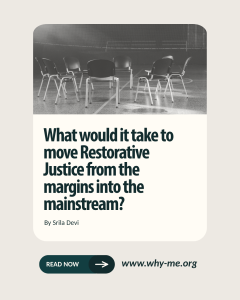
What would actually need to change for restorative justice to become a more established part of the UK’s justice system, following the lead of countries such as Belgium, New Zealand and Rwanda? And what can each of us do to be part of this change?
Raising public awareness and challenging misconceptions
Lack of public awareness may be one of the greatest obstacles to making restorative justice more widely available. When I started training as a restorative practitioner, I was struck by how many people did not know what restorative justice was, let alone that it was an option available to victims of crime.
Another significant problem is the persistence of a ‘tough on crime’ narrative in sections of the British media, particularly the tabloid press. Approaches that emphasise rehabilitation, reintegration or repair are often portrayed as ‘soft’ alternatives to punishment, while longer sentences and harsher penalties are presented as evidence that justice is being served. This both reflects and shapes public attitudes, making it politically more difficult to advocate for restorative approaches.
One of the most important ways we can help to change this is by taking the conversation about restorative justice beyond specialist circles and into the mainstream. Organisations such as Why me? already do vital work raising awareness and advocating for greater access, but each of us can help bring the conversation to people who might otherwise never encounter it. We can write letters to newspapers, suggest restorative justice as a topic to local radio or television, invite practitioners to speak at community groups, libraries, schools or workplaces, or organise public discussions in collaboration with local police, victim services and other criminal justice organisations.
Those of us who write, teach, speak publicly or work within the criminal justice system have particular opportunities to do this. The aim is not just to preach to the converted, but to make restorative justice part of the wider public conversation about what justice is for.
Changing political priorities
For restorative justice to become a more established part of the justice system, it needs political support. Public awareness and mainstream media coverage can help create a climate in which restorative approaches are taken seriously, but we can also engage directly with decision-makers. We can write to our MPs, ask what they and their parties are doing to increase access to restorative justice, encourage them to raise the issue in Parliament and respond to relevant government consultations.
Here, evidence matters. Rather than simply telling politicians that we believe restorative justice is a good idea, we can point them towards research on its effectiveness and ask why, at a time when the UK is facing a prison crisis, restorative approaches are not playing a greater role in criminal justice policy.
Increasing Funding
Funding is another major challenge. The average cost of keeping one person in a public-sector prison in England and Wales has risen to more than £60,000 a year. Against the backdrop of a cost-of-living crisis, this is an extraordinary amount of public money, yet there seems to be relatively little public debate about whether some of this expenditure could be better invested in restorative approaches. How does the cost of imprisonment compare with the cost of employing and training restorative practitioners and providing properly funded restorative services?
Supporting and fundraising for organisations working in the field can certainly help, but charitable funding alone cannot solve a structural problem. We also need to make the economic case for restorative justice part of the public conversation and use the available evidence to question spending priorities and support campaigns for sustained investment in restorative services. The question is not simply whether we can afford to fund restorative justice, but how we choose to spend the money already allocated to criminal justice.
Following the Evidence
Crucially, these conversations need to be grounded in evidence. There is a growing body of research into restorative justice, alongside testimony from victims and others who have taken part in restorative processes. Bringing this evidence and lived experience into mainstream discussions can help challenge the idea that rehabilitation, reparation and restoration are ‘soft’ or ineffective alternatives to ‘real’ justice. It can also help shift the debate away from what sounds toughest towards what actually works.
Politicians need to be willing to follow the evidence, even when doing so may be politically difficult. As long as being ‘tough on crime’ is seen as electorally advantageous, they may be reluctant to champion restorative approaches, regardless of what the evidence tells us. This is another reason why changing the public conversation matters. Politicians ultimately answer to voters, and greater public understanding of restorative justice can create more political space for evidence-based approaches to crime and punishment.
If restorative justice is to move from the margins into the mainstream, it needs to become embedded in how we think about justice itself. Belgium gives us a striking example of what that shift can look like. Vandermeersch speaks of restoring social balance, repairing harm, taking responsibility and changing trajectories. Change on that scale requires political leadership, sustained funding and infrastructure, but it also requires a public conversation that allows us to imagine justice as something more than punishment.