This is a blog by our Communications and Campaigns Manager, Keeva Baxter.
What happens when you put senior decision-makers, people with lived experience of Restorative Justice, an expert RJ service and a range of criminal justice professionals in a room to discuss Restorative Justice? Transformation, commitment and lasting change are some of the words that come to mind having been in exactly that room a few weeks ago.
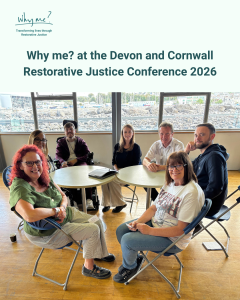
Why me? co-facilitated a pioneering event in Plymouth, bringing together criminal justice professionals from across Devon, Cornwall and the Isles of Scilly to discuss Restorative Justice. Led by Mark Ansell, the High Sheriff, the event highlighted an array of stories of people who had been through the restorative process and ended with a series of concrete actions for the attendees to take away into their roles.
We all know that one of the largest barriers to people accessing Restorative Justice is that they never get told it’s an option. By changing the hearts and minds of the criminal justice professionals who support them, we break this cycle and ensure that everyone gets the information they need to make an informed decision about their healing.
Who was in the room?
The High Sheriff ensured that the conference was attended by a wide range of people from senior leaders like Police and Crime Commissioner, Alison Hernandez and the Chief Constable, James Vaughan to lived-experience speakers including our Ambassador, Janika. The local Restorative Justice service, Make Amends, were there, alongside their RJ Coordinator, Mark Myers, who bridges the gap between the restorative service and the police. Delegates included police officers, probation, victim support services, youth justice organisations and many more.
The true power of the day was the collection of stories that showed the variety and strength of the restorative process. The day started with Jacob Dunne and David Hodgkinson, whose story is depicted in the play Punch. Jacob threw a single punch on a night out that resulted in the death of paramedic James Hodgkinson. After an exchange of letters, Jacob met face to face with David and Joan, James’ parents in a restorative process. Jacob and David shared their experience, and how they have gone on to work together, raising awareness of both Restorative Justice and one-punch manslaughter.
Next came Paula Reynolds, who was denied access to Restorative Justice after her son Adam experienced a serious knife attack on a night out. Having seen her son as he was haemorrhaging in the hospital room from his facial wounds, Paula was left with lasting trauma and unanswered questions. Despite over four years of pursuing a restorative process, Paula was consistently denied it, being told that as she wasn’t the primary victim, she couldn’t take part. Eventually, she took the decision to step away from the process as it was too traumatic to continue seeking the resource she knew she needed to heal. Paula’s testimony really brought home the devastation caused by being denied access to Restorative Justice, a situation which sadly many more are facing today. Paula graciously shared how pleased she was that others in the room had been able to access it, and highlighted her conviction for ensuring that others don’t face the same barriers that she did.
Later in the day, we heard from Seth and Julie Marks, who shared their story of both going through Restorative Justice following a road traffic collision that left Seth with life-changing injuries. After a night out, Seth got in a car with his best friend Harry, who had been drinking. Seth had not been wearing a seatbelt and the car crashed, leaving Seth paralysed. Living in a small community, the collision had wide ripple effects which divided the community. For Seth, the restorative meeting was about getting his questions answered and reconnecting with his friend. Seth’s mother, Julie, on the other hand, wanted something else, “I wanted him to understand the absolute devastation he had caused”. Julie got the answers she needed and says that “without Restorative Justice, I wouldn’t be the person I am today, or here at all”. Harry and Seth continue to be friends, still going to the pub together, and Seth is now Godfather to Harry’s son. The meeting wasn’t just transformative for the three people involved, it impacted the entire community. A village ripped apart by what had happened, were able to come back together after learning that Seth and Harry had met and were friends again.
The final speaker of the day was Why me? Ambassador Janika. After being stabbed by her ex-partner, Janika was left having open-heart surgery, not knowing if the child she was 9-weeks pregnant with had survived. By a miracle, both her and her son survived. But it wasn’t just the physical injuries that Janika was left with. Having lost her car, her house, her job and much more, she was left with insomnia, PTSD and ongoing trauma. After fighting for her life, she now had to fight for justice. After requesting Restorative Justice repeatedly for years, she was consistently told that it wasn’t appropriate for her case. Eventually, Janika was able to access a restorative process that changed her life. By confronting her ex-partner, she was able to take her power back – “the meeting was the most powerful, nerve wracking and empowering thing… I can actually see my future in front of me”. Janika ended by explaining the importance of professionals not gatekeeping and preventing survivors from accessing Restorative Justice.
This range of stories was interspersed with delegates identifying barriers to Restorative Justice and how they can be dismantled. The room was split into groups which were each assigned a crime type relevant to their area of work:
- Domestic abuse and sexual violence
- Youth
- Road traffic incidents
- Serious violence
- Retail crime
- Anti-social behaviour
- Assaults on emergency workers
- Hate crime
The day ended with the Chief Constable, James Vaughan declaring that “I have been converted” and delegates discussing specific actions to take into their day jobs.
How do you get the buy-in of decision makers and criminal justice professionals?
The learnings from this unique and successful day left me reflecting on what we can do to bring criminal justice professionals and senior leaders with us. The following are good first steps:
- Platform the voices of lived experience, ideally with a wide range of stories
- Explain how to make a referral to the local service, making it as easy as possible for professionals to refer
- Discuss a wide range of crime types, from road harm and retail crime to domestic violence
- Acknowledge the challenges, whilst highlighting the opportunities
- Emphasise the risk assessment that goes into the process
- Help professionals to understand the barriers that people affected by crime face (including those they may inadvertently be causing) and how to overcome them
- Leave with clear actions, with someone responsible for delivering them
If you are interested in running something similar in your area, get in touch via info@why-me.org to find out more and discuss how we can support you.
Thank you to Mark for putting together such a powerful event and to Jacob, David, Paula, Julie, Seth and Janika for sharing your incredible stories. We also want to extend our thanks to Make Amends, Mark Myer, Katie and Theatre Royal Plymouth, Alison Hernandez and her team and all those who made it happen.