This is a blog by our RJ Programme Manager, Anika Cosgrove.
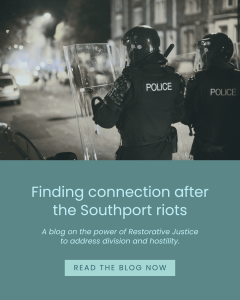
Last week, the Guardian shared an article about how Restorative Justice supported a woman who was involved in the Southport riots. This speaks to the wider power of restorative interventions to tackle hate-motivated crime, conflict within communities and division.
Following the Southport stabbings in which 3 young girls were murdered, riots and unrest broke out across the country. In Middlesborough, Stacey Vint, a 34 year old mother of five, was filmed pushing a burning wheelie bin towards a line of police officers, leading to a 20-month prison sentence for violent disorder.
Seeing the footage of Stacey’s crime on TV, retired primary school teacher Satti Collins recognised her as a former pupil. “I just wanted to know why she did that,” she said. “I wanted to find her, but I didn’t know how.” Supported by Cleveland’s Safer Communities, the two were put in touch through a restorative process.
Stacey explained that bereavement, losing custody of her children, and drug and alcohol addiction left her wanting to block everything out. On her journey to buy alcohol she had become “caught up in the crowd” of unrest. “Within seconds everything turned to madness… The atmosphere just took over me.”
Meeting her former teacher through Restorative Justice and her time in prison allowed Stacey to reflect on the impact of her actions, “People were frightened in their homes. Cars smashed up. Windows boarded… I had never thought about how my actions affected anyone else.” Since the meeting, Stacey and Satti have stayed in contact and have spoken publicly together about their experience.
Reflecting on Stacey’s journey, Satti says “She is brave and honest, and she has worked so hard to turn her life around. It’s wonderful and she is really making a difference in sharing her story with others.”
The story of Stacey and Satti beautifully illustrates the transformative power of Restorative Justice in addressing the aftermath of conflict and crime. This approach not only facilitates healing for those directly involved but also highlights the importance of understanding the broader impact on the community.
Restorative Justice also serves as a much-needed mechanism for mending the fabric of society after incidents like the riots in Middlesbrough. By inviting individuals like Stacey to engage in meaningful dialogue with those affected, Restorative Justice creates an environment where accountability and empathy can flourish. This process moves beyond punishment, instead focusing on understanding the underlying issues and lived experiences that can lead to harm that impacts a person.
Through their conversations, Stacey gained insight into the fear and disruption her actions caused, while Satti was able to understand the struggles that led Stacey to that moment. This exchange not only facilitated healing for both parties but also created a deeper connection that surpassed their past roles as teacher and student.
The story of these two women highlights that the consequences of crime extend beyond direct victims. The ripple effect of harm reaches all parts of the community. Indirect victims, such as community and family members, experience their own forms of trauma and a need to understand and be heard. Restorative Justice acknowledges these voices. This holistic approach reinforces that the healing of both direct and indirect victims’ matter.
The power of Restorative Justice lies in its ability to transform harm into healing through dialogue, recognition of indirect victims, and the development of human connections. This approach not only facilitates individual growth but also strengthens communities, paving the way for a more compassionate and understanding society. It’s a reminder that even in the wake of chaos, there is potential for redemption, understanding, and meaningful change.
At Why me?, we see first hand how dialogue can be transformative in addressing divisions in communities and hate-motivated harm. Our Building Peace project, in collaboration with the Faith and Belief Forum and Interfaith Glasgow explores how Restorative Justice can be used to address hostility against or between faith groups.