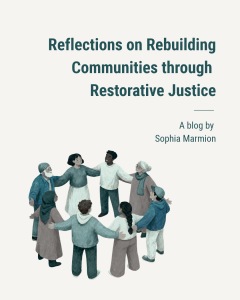
This is a blog by Why me? Volunteer, Sophia Marmion.
This year, Restorative Justice Week has provided a time to amplify the word about Restorative Justice (RJ) and examine the barriers many face in accessing it. This year’s RJ Week theme has centred the role of community and the use of restorative rather than punitive responses to harm. At an event held on Thursday, Why me? welcomed speakers Jo Berry CBE, Jake Ferris, Paul Kohler MP and Sheldon Lazarus to explore their experiences and perspectives on the topic of ‘Rebuilding Communities through RJ’.
Insights from the speakers
As the session kicked off, Jo Berry shared her journey of reconciliation to meeting Patrick Magee, the man responsible for planting the IRA bomb that killed her father, Sir Anthony Berry MP. Drawing on her experiences working as an RJ facilitator, Berry described the importance of RJ for both individual and community healing. She says that restorative processes can help both victims and perpetrators move past a single-sided certainty towards acknowledgement and healing, showing that moving forward is possible.
Jake Ferris brought perspective on the restorative roles and responsibilities of active community spaces, drawing on his experiences cultivating safety in Belfast’s LGBTQIA+ nightclub. Ferris described the process of protecting safe spaces after harm, where restorative practices foster open conversations to identify the impact of harm among the community before collaboratively deciding how to address them. Within an essential community space, Ferris centres the importance of resolution and closure, whether by barring individuals or holding restorative conversations, as people will continue to come into the same space and encounter each other.
Speakers Paul Kohler MP and Sheldon Lazarus directly linked their stories and RJ experiences with community effects. Kohler spoke to community ripple effects, as the narrative of his story was rewritten by media and politicians in the midst of the 2014 pre-Brexit landscape. Kohler also identified the frequent portrayal of RJ in the media as solely an individual mechanism to ‘go and forgive,’ whereas it is completely up to the victim whether or not to do so. Lazarus built on deconstructing the individual-centred narrative that often surrounds RJ, sharing how the Barnet Youth Offending Services reached out to him directly several times to offer support and a community mechanism to address the harm he experienced.
Our key takeaways
The session provided a reflective space for how best to rebuild communities through RJ. Speakers Paul Kohler MP and Jake Ferris emphasised the importance of legislation and supportive infrastructure in this process, identifying areas for improvement. Ferris called attention to the effects of the lack of hate crime legislation in Northern Ireland, where failures in policy or legal infrastructure leave massive gaps that RJ processes could be used to fill. RJ in this context has worked to a certain degree, Ferris says, but the current review of legislation in Northern Ireland should strengthen accountability and the right to lean on RJ in the Victim’s Code. Kohler also identified avenues for improving legislative support for RJ, as he is pushing to include RJ in the current Troubles Bill going through Parliament.
While legislative and supportive infrastructure for RJ processes are an important avenue, speakers emphasised the necessity of embedding restorative culture within communities holistically. Jo Berry and Sheldon Lazarus identified education and advocacy as key mechanisms in this process. Where vulnerability is often portrayed as weakness, Berry said, we should teach and model curiosity and empathy to young people, so that these normalised practices will drive decision-makers.
Embedding restorative culture within communities should include wider representation of implementation. Paul Kohler referenced mainstream images of polarisation in the political system, where people tend to see parties vocally divided in PMQs. However, behind the scenes restorative practices are more common, as MPs collaborate and foster healthy dialogue while solving problems in select committees.
However, it is important not to frame RJ as right for everybody, or as a process that puts responsibility on those harmed to change others’ minds. Rather than treating RJ as a panacean response to harm, Jake Ferris advocated for recognizing the potential of RJ to prevent community fracturing in the first place, especially through education.
The session’s takeaways around restorative practices and community rebuilding reflect some of the key messages in Why me?’s ongoing Interfaith Restorative Justice Project, where communities in Glasgow and Solihull have been using RJ practices to address faith based harm. These practices can facilitate important changemaking processes in communities and remind people that their neighbours care. If you are interested in hearing more reflections on using restorative practices in community settings, join us on the 1st of December for an event on Faith-Based Harm.
If you would like to have your say on next year’s RJ Week theme, share your ideas in our short form.