This is a blog by our Communications and Campaigns Manager, Keeva Baxter.
The Youth Justice Board have published a new report on the ‘Quality and methodology information for youth justice services’ key performance indicators’. In 2022, 10 new key performance indicators (KPIs) were given to Youth Justice Services in England and Wales, that they were then obligated to demonstrate their progress towards every quarter.
One of these KPIs revolves around Restorative Justice as follows:
KPI 10 – Victims
The number of victims engaged in restorative justice opportunities as a proportion of the total number of victims who consent to be contacted.
We know that the implementation of these 10 new KPIs had a significant impact on Youth Justice Services and their reporting processes. In this blog, we explore some of the findings of the report, the data collected on Restorative Justice and what this means for the sector.
What does the report say?
The new report shares the data that the YJB has collected in the first reporting year, between 2023 and 2024. Overall, the YJB reports that “The majority of YJSs consistently submit data each quarter, ensuring a large coverage of data.”
They find that while the data is not high quality enough to inform decision making at this point, “from Quarter 1 of 2025/2026, the data will be of sufficient quality to support analysis and evidence-based decision-making, marking a significant step forward in the KPI data collections maturity.” When it reaches this level of maturity in 2025/2026, the data will help to inform how children are supported, identify strengths and gaps in service provision, support the MoJ to understand barriers to reducing reoffending, and strengthen multi-agency collaboration.
What are the challenges?
The YJB outline a number of challenges that they have faced in the first stages of this data collection. They include the following:
“Data quality issues: The absence of a pilot phase for the KPIs presented challenges, such as recording inconsistencies and data field gaps. These issues have impacted the accuracy of the data, including overreporting and underreporting of children. Targeted improvements have been made because of significant engagement between the YJB and the sector, and data quality is a continuous improvement process, to enhance accuracy and reliability.
Inconsistency of definitions: Variation in how YJSs interpret certain definitions has highlighted the need for clearer, standardised guidance. This feedback has informed the development of updated KPI recording guidance, due for release in summer 2025, to support greater consistency and comparability.
Data gaps: Some YJSs have missing data for KPI 10 (Victims) due to CMS errors, leading to underreported figures. These have been identified, and a system fix is in place, with improved quality expected in 2025/2026 data, ensuring more complete and representative data moving forward.
Human error: Data entry errors, such as misreporting intervention programme details, have highlighted the importance of ongoing training. In response, the YJB has delivered national webinars and training materials to support accurate and confident data recording.
Limited use for analysis during pilot phase: Data from the 2023/2024 and 2024/2025 reporting years is being treated as a pilot phase to allow for refinement.”
The 10th KPI and Restorative Justice
The 10th KPI is a step in the right direction to recognise the incredible restorative work done by Youth Justice Services. In 2022, Why me? submitted a series of recommendations that were developed as part of a restorative consultation we held alongside Oxfordshire Youth Justice Service’s Senior RJ Practitioner, Pete Wallis. This led to the inclusion of Restorative Justice in the YJB’s new KPIs.
The data collected on the ‘Proportion of victims engaged with Restorative Justice’ is laid out in the table below.

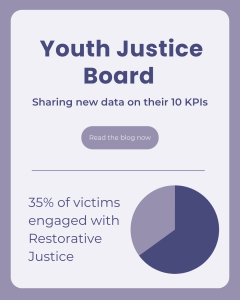
The engagement of only 35% of victims of crime with the Restorative Justice process is not as high as we would like to see, however, this can be attributed to a number of factors. Firstly, we know that the data may be unreliable, with cases unaccounted for and data not shared from all services.
The word ‘engaged’ is also arguably open to interpretation differently by different services. However, the YJB did publish new guidance on reporting to the new KPIs in June 2025, which gives further detail on what counts as a ‘victim engaged’. In this document, they say:
“A victim is counted as having engaged in RJ if they requested, accepted, received, started, or completed any of the following: • RJ communication: RJ letter, apology letter, victim-child letter. • Verbal apology. • Direct reparation. • Indirect reparation, or community reparation as requested by the victim. • RJ mediation: Shuttle mediation, conference, panel, or face-to-face meeting.”
We commend the wide definition of what falls under this category, as it demonstrates the true value and range of the restorative work that the YJS is doing, rather than just counting direct restorative interventions completed. This guidance could make a significant difference to the accuracy of the data moving forwards.
The data for Wales reflects a significantly higher proportion of victims engaged in Restorative Justice compared to England. It is encouraging to see that RJ can be accessed by a majority, and we hope to see this replicated in England. If any of our network in youth justice across Wales would like to share their approach and what works well, we’d love to hear it.
Ultimately, while there is still space for growth, both in the improvement of data collection and the number of victims engaged in Restorative Justice, we are pleased that data is being collected and look forward to using the accurate data from the next report for lobbying decision-makers.
If you work in the youth justice sector, you may also be interested in the work we did around how Youth Justice Services can meet the new victims’ standard.